
Preparing for your certification exam? ASPEN offers a wide range of resources to help you prepare. Browse the resources below to see which are best for the exam you are preparing for and your learning style.
Suggested Studying Strategies
| I need to… | Suggested Tool |
|---|---|
| Assess areas of strength and weakness | Self-Assessment Program |
| Review various aspects of and topics in nutrition support and clinical nutrition | Nutrition Support Fundamentals Course |
| Strengthen my patient-based decision-making by reviewing case studies | ASPEN Adult Nutrition Support Core Curriculum, 4th Edition |
| Test my knowledge by practicing on the “Test Your Knowledge” Questions | ASPEN Adult Nutrition Support Core Curriculum, 4th Edition ASPEN Pediatric Nutrition Support Core Curriculum, 3rd Edition |
| Practice online testing by taking practice tests | Self-Assessment Program |
| Search for guidelines, practice recommendations, particular facts, formulas, and definitions I need to review | Clinical Practice Library |
Books
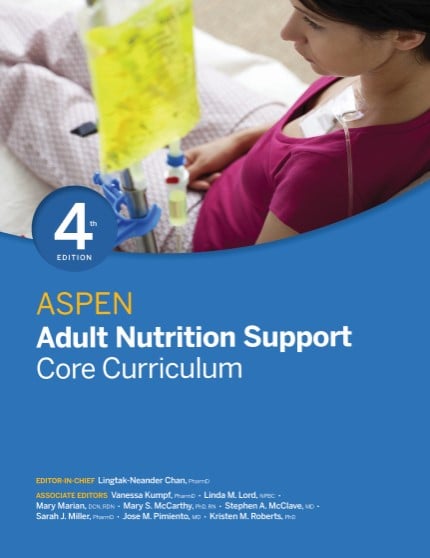
ASPEN Adult Nutrition Support Core Curriculum, 4th Edition
Editor-in-Chief: Lingtak-Neander Chan, PharmD, BCNSP, FASPEN. American Society for Parenteral and Enteral Nutrition, 2025.
This comprehensive book addresses the principles of nutrition support and nutrition support recommendations for selected medical and surgical conditions. It’s completely rewritten and includes updated guidelines, “Test Your Knowledge” practice scenarios, and questions.
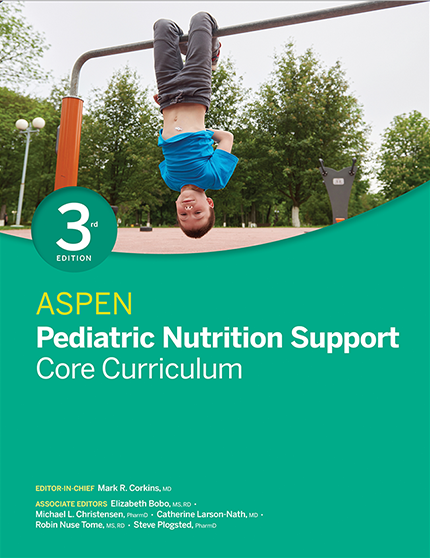
ASPEN Pediatric Nutrition Support Core Curriculum, 3rd Edition
Editor: Mark R. Corkins, MD, CNSP, SPR, FAAP. American Society for Parenteral and Enteral Nutrition, 2024.
Focuses on the pediatric patient and the importance of nutrition to the growth and development of children. It is written with an interdisciplinary, evidence-based approach and is designed to meet the educational needs of all involved in the nutrition care of pediatric patients.
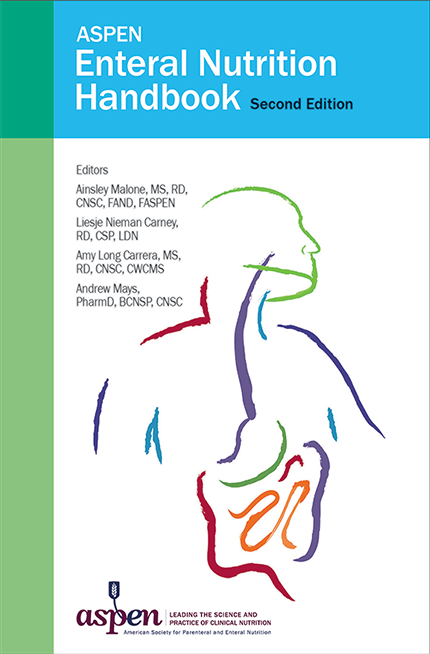
ASPEN Enteral Nutrition Handbook, Second Edition
Editors: Ainsley Malone, MS, RD, CNSC, FAND, FASPEN; Liesje Nieman Carney, RD, CSP, LDN; Amy Long Carrera, MS, RD, CNSC, CWCMS; Andrew Mays, PharmD, CNSC. American Society for Parenteral and Enteral Nutrition, 2019.
A comprehensive resource on how to safely and effectively care for patients receiving enteral nutrition. The handbook includes recommendations from the 2016 ASPEN Safe Practices for Enteral Nutrition, and a new chapter on preparation, labeling, and dispensing of enteral nutrition.
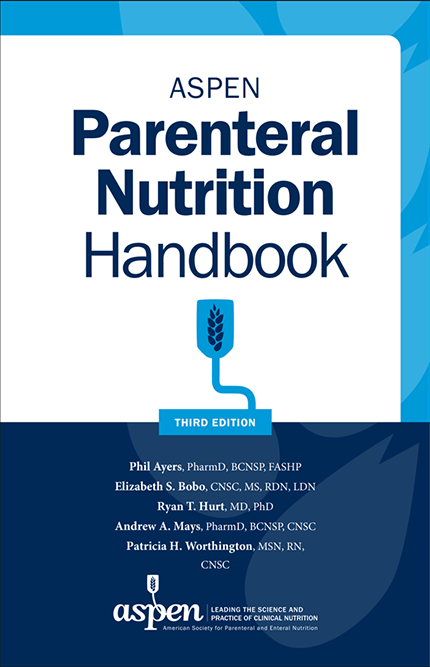
ASPEN Parenteral Nutrition Handbook, Third Edition
Editors: Phil Ayers, PharmD, BCNSP, FASHP; Elizabeth S. Bobo, CNSC, MS, RDN, LDN; Ryan T. Hunt, MD, PhD; Andrew A. Mays, PharmD, BCNSP, CNSC; Patricia H. Worthington, MSN, RN, CSC.
This new edition is updated with the latest ASPEN safety consensus recommendations and clinical guidelines. It features comprehensive information to help practitioners safely, effectively, and confidently care for patients receiving parenteral nutrition.
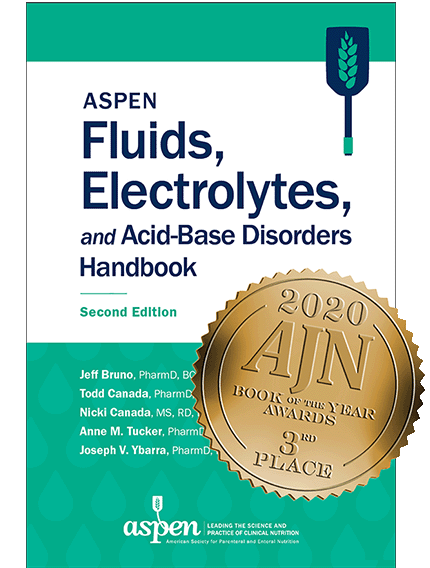
ASPEN Fluids, Electrolytes, and Acid-Base Disorders Handbook, Second Edition
Editors: Jeff Bruno, PharmD, BCPS, BCNSP, BCCCP, FCCM; Todd Canada, PharmD, BCNSP, FASHP; Nicki Canada, MS, RD, LD, CNSC; Anne M. Tucker, PharmD, BCNSP; Joseph V. Ybarra, PharmD, BCNSP
Edited by a multidisciplinary team of experts, this second edition of ASPEN Fluids, Electrolytes, and Acid-Base Disorders Handbook provides the foundation needed to treat these complex conditions, and it is also ideal for bedside use.
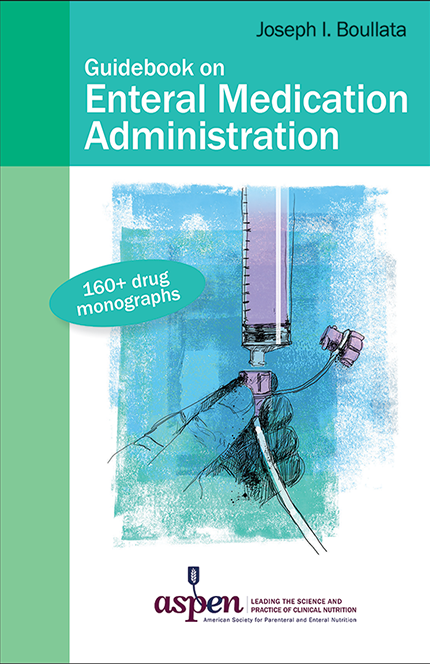
Guidebook on Enteral Medication Administration
Editor: Joseph I. Boullata, PharmD, RPh, BCNSP, FASPEN, FACN
This handy reference for clinicians involved in managing patients with an enteral access device combines information on the foundational science that underpins the approach to enteral medication, along with specific recommendations for individual medications.
Online Learning Programs & Resources
The ASPEN Self-Assessment Program is a valuable resource for assessing your strengths and weaknesses in several key areas of nutrition support. The program is module-based, meaning you can work with ease in one content area or in many. Purchase the entire program or only the modules you need. Each module contains a pre-assessment and a post-assessment. After you answer each question, you will be shown the correct answer, commentary/rationale, and references. Content can be accessed for the duration of your subscription. A practice test of 100 random questions from all modules is included with the purchase of the full program. Up to 20 CE credits can be earned for successful completion of all modules in the Self-Assessment Program. CE Credit is not available for the Practice Test.
Click here for more information on the Self-Assessment program.
The Nutrition Support Fundamentals Course is a multi-part program taught by interprofessional faculty experts. It provides a comprehensive overview of nutrition support therapy that is applicable to all members of the healthcare team. Course topics include malnutrition, pediatric and neonatal nutrition, parenteral and enteral nutrition, acid-base, and more. This course can help identify knowledge gaps for individuals and members of the healthcare team, guide future areas of learning, and may also help participants prepare for certification exams. Additionally, attendees can earn valuable CE credits.
Click here for more information on the Nutrition Support Fundamentals Course.
ASPEN’s Clinical Guidelines, Standards of Practice, and Safe Practices provide clinical advice to the health care professional administering specialized nutrition support for adult and pediatric patients in the hospital or home. These documents are available online in the Clinical Practice Library and in printable format for both members and Library subscribers. Access the Library.
Suggestions from the Certification Boards
Information on studying and resources can be found on each of the certification programs’ websites.
- Certified Nutrition Support Clinician Certification (CNSC)
- Nutrition Support Pharmacy Specialty Certification (BCNSP)
- Physician Nutrition Specialist (PNS)
Disclaimer: The references listed above may be of some help in preparing for the examinations offered by the NBPNS, BPS, or NBNSC. The list does not attempt to include all acceptable references nor is it suggested that the certification examinations are based on these references.